PART 2 — THE SECRET BENEATH THE WHITE BOTTLES
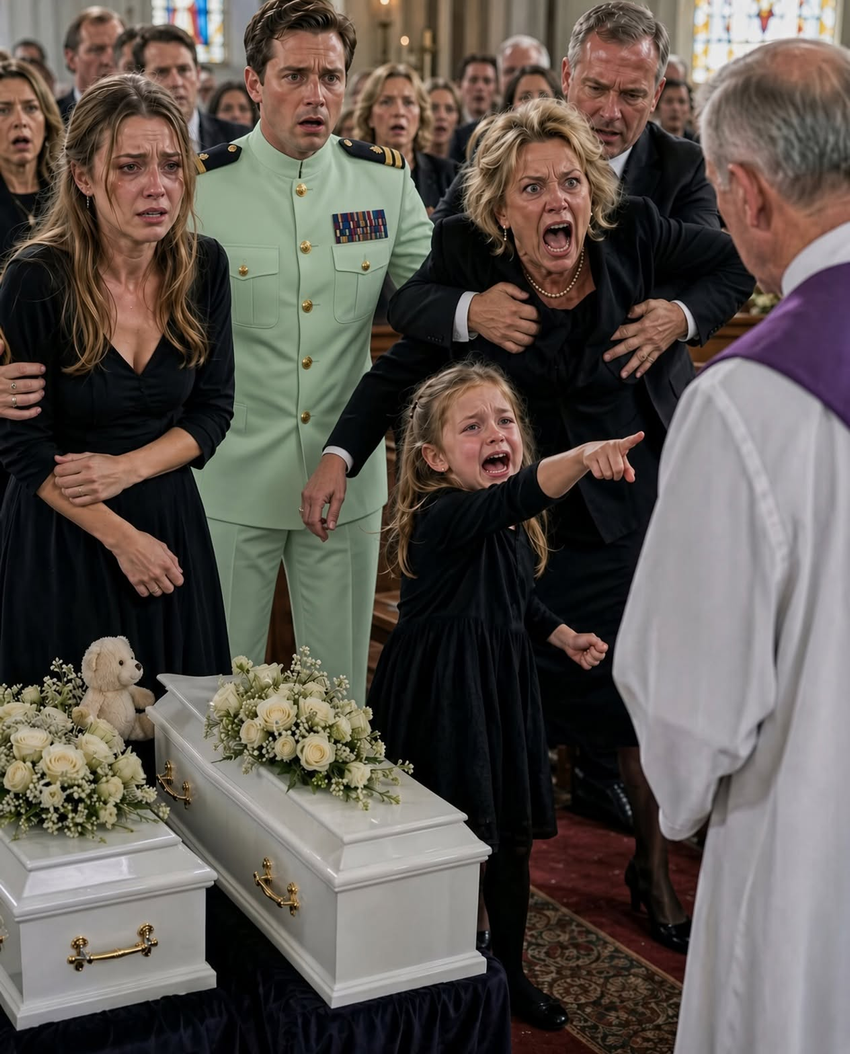
For three terrible seconds after Margaret’s outburst, nobody inside St. Matthew’s Chapel moved.
Not Trevor.
Not Pastor Daniel.
Not the ushers standing beside the doors.
Not even me.
The only sound was Emma crying.
My four-year-old daughter stood beside the pulpit with both hands pressed against the front of her little black dress, staring at her grandmother as though she had suddenly realized that adults could become monsters while still wearing pearls.
Margaret’s last words seemed to hang above us.
“They were ruining everything! Trevor would have wasted his life with those children and her!”
She had pointed at me.
At the mother standing between the two tiny white coffins.
At the woman she had spent years calling weak, unsuitable, unstable, dramatic, needy, and unworthy of her son.
But this time, everyone had heard her.
Trevor released my arm.
Slowly.
His expression had changed.
A moment earlier, he had been furious with me for shouting at his mother.
Now he looked as though the floor had disappeared beneath his feet.
“Mom,” he whispered. “What did you mean by that?”
Margaret’s eyes darted toward the exit.
Pastor Daniel stepped between her and the aisle.
“Nobody is leaving,” he said quietly.
Margaret laughed.
It was a horrible sound.
Sharp.
Breathless.
Almost offended.
“You cannot detain me in a church.”
“No,” Pastor Daniel replied. “But the police can.”
Someone near the back was already calling.
Margaret spun toward Emma.
“You don’t know what you saw.”
Emma flinched.
I moved before I even realized I was moving.
I crossed the space between us and pulled my daughter against me.
Margaret lifted one shaking finger.
“She is four years old! Children invent things. They misunderstand. They repeat nonsense!”
Emma buried her face against my stomach.
“No,” she sobbed. “I saw you.”
Margaret opened her mouth.
Emma lifted her tear-soaked face.
“You were in Aunt Claire’s kitchen.”
The entire room seemed to inhale.
Margaret stopped breathing.
So did Trevor.
I looked down at Emma.
“What did you say?”
Emma wiped her nose against the back of her hand.
“The kitchen with the blue chairs.”
Trevor’s sister Claire lived twenty minutes away.
She had hosted Margaret for two nights that week because Margaret’s kitchen was being renovated.
Trevor stared at his mother.
“You told me you never went to Claire’s house that week.”
Margaret’s face hardened.
“I forgot.”
“You forgot where you slept?”
“I was upset!”
Emma tugged at my sleeve.
“Mommy?”
I crouched beside her.
“What, sweetheart?”
“There was a bag.”
My heart stopped.
“What kind of bag?”
“A little silver bag.”
Margaret lunged forward.
“Enough!”
Pastor Daniel caught her by the shoulders.
She fought him so violently that two ushers rushed over.
“Let me go!” Margaret screamed. “That child is confused!”
Emma began shaking.
I wrapped both arms around her.
“What was in the bag?” I whispered.
She looked toward Margaret.
Then toward the coffins.
“Grandma poured it into the bottles.”
Every person in the chapel heard the sirens arriving outside.
Margaret went completely still.
Trevor backed away from her.
For the first time in ten years of knowing him, I saw fear on my husband’s face when he looked at his own mother.
Police officers entered the chapel less than four minutes later.
Those four minutes felt longer than the entire previous week.
Pastor Daniel explained what had happened.
Several relatives began speaking at once.
My sister Olivia was screaming that Margaret had confessed.
Trevor’s uncle insisted everyone needed to calm down.
Someone had recorded part of the confrontation on a phone.
Someone else had photographed the mark on my forehead where Margaret had struck me against the coffin.
And through all of it, Margaret kept saying the same thing.
“This is absurd.”
“This is hysteria.”
“The child is confused.”
“I said nothing.”
But there were more than sixty witnesses.
And Emma had said something only a person who had been inside Claire’s kitchen could have known.
The blue chairs.
Claire arrived ten minutes later.
When the police asked whether Margaret had stayed at her house that week, Claire’s face went white.
“Yes.”
Trevor turned toward her.
“You told me she was staying at the hotel.”
Claire looked at Margaret.
Margaret stared back.
Something passed between them.
Something silent.
Something terrified.
I saw it.
And so did the detective standing beside us.
His name was Detective Aaron Walsh.
He was in his early fifties, with tired gray eyes and a voice so calm it made everyone else sound frantic.
“Mrs. Holloway,” he said to Claire, “why did you tell your brother something different?”
Claire swallowed.
“I—I didn’t.”
Trevor stepped forward.
“You absolutely did.”
“I said she might have gone to the hotel afterward.”
“No. You said she never stayed with you.”
Claire looked away.
Detective Walsh wrote something in his notebook.
Margaret suddenly laughed again.
“This family is grieving. You’re twisting ordinary confusion into some grotesque accusation.”
Walsh looked at her.
“Nobody accused you of anything yet.”
Margaret’s smile disappeared.
That was when I understood.
She had just made her first mistake.
The police separated everyone.
The memorial service ended without a prayer.
Without music.
Without the final blessing I had imagined giving my sons.
Instead, my family walked out through the side entrance while two officers escorted Margaret through another.
She was not formally @rrested that afternoon.
Not yet.
There was only Emma’s statement, Margaret’s furious words, and the growing list of contradictions.
But investigators reopened everything surrounding the twins’ sudden d/e/@/ths.
Everything.
The bottles.
The formula.
The pediatric records.
The bedding.
The babysitting schedule.
The people who had been inside our home.
The timeline from the final forty-eight hours.
And, most importantly, the toxicology samples that had been retained after the original examination.
I did not know that those samples would become the key to everything.
I did not know that one tiny number written on a laboratory sheet would tear apart two families.
That night, I refused to return home with Trevor.
Olivia took Emma and me to her apartment.
Trevor stood beside our car in the church parking lot.
“Sarah.”
I kept fastening Emma into her seat.
“Sarah, please.”
I closed the buckle.
“Please what?”
“Talk to me.”
I turned.
For years, Trevor had been the person I trusted most.
The father who had slept beside the twins’ cribs during their first fever.
The husband who had held my hand while I cried after we learned we were expecting two boys.
The man who had painted their nursery pale green because he said blue was boring.
And that afternoon, while his mother humiliated me beside our sons’ coffins, he had grabbed me and told me to leave.
“What do you want me to say?” I asked.
His eyes filled.
“I was wrong.”
“You defended her.”
“I didn’t understand what was happening.”
“You watched her hit me.”
“I know.”
“You watched her grab my head.”
His mouth tightened.
“I know.”
“And you told me to leave.”
He looked down.
“I thought you were making everything worse.”
The words cut deeper because they were honest.
I nodded.
“That is exactly the problem.”
He looked up.
“Sarah—”
“You thought I was the problem because your mother trained you to think I was the problem.”
He said nothing.
“She insulted me through two pregnancies. You said she was adjusting.”
He closed his eyes.
“She criticized how I fed Emma. You said she meant well.”
“Sarah—”
“She told people I trapped you with children. You told me to ignore her.”
“I know.”
“She walked into our house without calling. She changed schedules. She contradicted doctors. She rearranged medication. She threw away food she didn’t approve of. She told Emma not to listen to me when Grandma was around.”
Trevor’s face crumpled.
“And every time,” I whispered, “you asked me to keep the peace.”
He leaned against the car.
“I failed you.”
“Yes.”
He began crying.
I had seen Trevor cry twice before.
Once when Emma was born.
Once when the twins were pronounced d/e/@/d.
I wanted to comfort him.
My body remembered loving him before my mind could stop it.
But I stayed where I was.
“Did you know she was at Claire’s?”
“No.”
“Did you know about the bottles?”
“No.”
“Did you know anything?”
“No.”
I believed him.
And somehow that made everything worse.
Because ignorance could still destroy a marriage.
“You need to go home,” I said.
“Where will you go?”
“With Olivia.”
“Can I see Emma?”
“Not tonight.”
He flinched.
“She’s my daughter.”
“And today she watched her grandmother hurt me while you defended her.”
He looked toward Emma through the glass.
My little girl was hugging the stuffed rabbit she had brought to the service.
Her face was blank.
“She needs safety more than explanations,” I said.
Trevor nodded.
I drove away.
Three days later, Detective Walsh called.
His first sentence changed everything.
“The preliminary toxicology review found something.”
My knees weakened.
Olivia pushed a chair underneath me.
“What?”
“There was a sedative compound present in both boys.”
The room tilted.
I gripped the table.
“What kind?”
“I don’t want to give you details until the lab confirms everything.”
“But it shouldn’t have been there?”
“No.”
I covered my mouth.
Emma was coloring at the counter.
A yellow sun.
A purple house.
Three stick-figure children holding hands.
She still drew the twins.
She always would.
“Could it have happened naturally?” I whispered.
“No.”
I shut my eyes.
The world I had been trying desperately to survive broke open again.
Their d/e/@/ths had originally been ruled unexplained but likely natural.
Two infants.
Same room.
Same night.
A statistical nightmare.
We had been told there was no sign of injury.
No obvious disease.
Nothing conclusive.
I had spent weeks blaming myself anyway.
Had the room been too warm?
Had I prepared something incorrectly?
Had I slept too deeply?
Had I missed a sound?
Every motherly instinct I possessed had turned against me.
Now Detective Walsh was telling me something had been inside them.
Something that did not belong.
“Was it in the bottles?”
“We don’t know yet.”
I looked at Emma.
“Margaret did it.”
Walsh paused.
“We’re investigating.”
“She said—”
“I know what she said.”
“She admitted—”
“She made incriminating statements. That is not the same as proving exactly what happened.”
I hated his caution.
But later, I would be grateful for it.
Because Margaret Holloway was hiding something.
Just not the whole thing.
The search warrant was executed that evening.
Officers searched Margaret’s house.
Claire’s kitchen.
Margaret’s car.
And eventually our home.
They found no mysterious silver bag at Margaret’s property.
But in Claire’s recycling bin, investigators recovered something Emma recognized immediately.
A silver foil pouch.
Empty.
The label had been torn away.
A pharmacy technician later identified adhesive residue consistent with a prescription packet.
Trevor called me when he heard.
“I can’t believe this.”
I almost laughed.
“You still can’t?”
“No. I mean—I believe Emma. I believe what she saw. I just…”
He stopped.
“You just cannot understand how your mother could do something monstrous.”
Silence.
“Yes.”
I looked out Olivia’s window.
“You spent years insisting she was harmless.”
“I was wrong.”
“You were.”
“I’m going to fix this.”
“You can’t fix our sons.”
His breathing broke.
“I know.”
The next development came from an unexpected place.
Claire.
At 11:43 that night, she appeared outside Olivia’s apartment.
She looked exhausted.
No makeup.
Hair wet from rain.
Hands trembling.
“I need to talk to Sarah.”
Olivia blocked the doorway.
“You can talk from there.”
Claire looked past her.
“Please.”
I walked into the hallway.
“What?”
Her eyes filled with tears.
“I lied.”
I felt cold.
“About what?”
“Mom staying at my house.”
“I know.”
“No. More than that.”
Olivia stepped closer.
Claire lowered her voice.
“The night the twins d/i/ed… Mom left my house.”
My entire body stiffened.
“What time?”
“Around eleven.”
The twins had received their final bottles shortly after midnight.
“Where did she go?”
“She said she was going for a drive.”
“How long was she gone?”
Claire covered her face.
“About an hour.”
Olivia swore under her breath.
I leaned against the wall.
“You knew?”
“I knew she left. I didn’t know why.”
“Why did you lie to Trevor?”
“Because Mom called me the next morning.”
Claire was crying now.
“She told me not to mention she had gone anywhere. She said people might ask questions because the timing looked bad.”
I stared at her.
“And that didn’t concern you?”
“She said she had driven past your house because she was worried about Trevor.”
“Did she go inside?”
“I don’t know.”
“You had cameras.”
Claire’s head snapped up.
Olivia and I looked at each other.
Claire lived in a newly renovated townhouse.
Trevor had installed her security system himself.
“You had a doorbell camera,” I said.
Claire went pale.
“It wasn’t working.”
“Claire.”
“It wasn’t.”
“Show me.”
Her hesitation answered before she did.
“What happened to the footage?”
She whispered something.
“What?”
“Mom deleted it.”
Olivia stepped forward.
“How?”
“She knew my password.”
I felt strangely calm.
“Did she delete only that night?”
Claire nodded.
That was when Detective Walsh received another phone call.
The security company retained cloud logs even when users deleted footage.
The videos themselves were gone.
But the access log remained.
At 11:19 p.m., Margaret’s account had logged into Claire’s camera system.
At 12:26 a.m., it had logged in again.
At 12:27 a.m., three clips were deleted.
Detective Walsh immediately requested technical recovery.
Two clips were damaged.
The third was restored.
The footage showed Margaret leaving Claire’s townhouse at 11:22 p.m.
She carried her purse.
And a small silver pouch.
She returned fifty-eight minutes later.
Without the pouch.
That was enough for police to @rrest her.
When they brought Margaret in for questioning, she demanded a lawyer.
Her furious confession at the church suddenly disappeared behind careful silence.
For two days, she said nothing.
Then her attorney introduced a new explanation.
Margaret admitted she had put something in bottles.
But she insisted the substance was harmless.
A vitamin supplement, she claimed.
Something she believed would help the twins sleep.
The toxicology result contradicted her.
She changed her explanation again.
Perhaps the bag had been mislabeled.
Perhaps Claire owned it.
Perhaps Emma had misunderstood which night she saw.
Perhaps I had added something later.
That final suggestion nearly destroyed Trevor.
He called me from outside the police station.
“She blamed you.”
I stared at the wall.
“Of course she did.”
“She told them maybe you were overwhelmed.”
I closed my eyes.
“She spent years telling everyone I couldn’t handle motherhood.”
“I know.”
“So now she is using the story she created.”
Trevor began crying.
“What have I done?”
I could have answered cruelly.
Part of me wanted to.
Instead I said, “You believed her long enough that she thought everyone else would too.”
That night, Trevor sent me an email containing only six words.
I will testify against my mother.
The investigation should have become simpler after that.
It didn’t.
Because the laboratory report contained a problem.
The amount of sedative detected in one twin was significantly higher than in the other.
Detective Walsh called it “an inconsistency.”
I called it terrifying.
“If she put the same powder into two bottles,” I asked, “wouldn’t the levels be similar?”
“Not necessarily.”
“But you don’t think the numbers make sense.”
He hesitated.
“No.”
“What are you saying?”
“I’m saying we may still be missing something.”
Investigators reexamined our kitchen.
Every cabinet.
Every bottle.
Every container.
Every trash record they could reconstruct.
They found nothing.
Then they examined photos taken inside our home the morning after the twins’ d/e/@/ths.
One photograph showed the kitchen counter.
Three bottles sat beside the drying rack.
Two ordinary transparent bottles.
And one white insulated bottle.
Emma saw the photograph during a child-specialist interview.
She pointed immediately.
“That one.”
The interviewer leaned closer.
“That one what?”
“That’s Grandma’s special bottle.”
My heart pounded.
“What do you mean?”
Emma looked at me.
“The one she brought.”
I froze.
Trevor had always purchased transparent bottles.
I remembered the white one.
But I had assumed it came from a sample pack.
I had been exhausted.
Grieving.
Barely functioning.
Detective Walsh traced the brand.
The serial code revealed it had been purchased from a baby boutique forty miles away.
Paid in cash.
The store kept security video.
And the person who purchased the bottle was not Margaret.
It was Claire.
When police showed me the footage, I stopped breathing.
Claire entered the store three days before the twins’ d/e/@/ths.
She purchased two identical white bottles.
Two.
Only one had ever been found.
Detective Walsh arrested Claire the next morning on suspicion of evidence tampering and obstruction.
Margaret broke her silence immediately.
“She made me do it!”
Claire broke hers within two hours.
“She’s lying!”
Mother and daughter turned on each other.
And what emerged was uglier than anything I had imagined.
Margaret had despised me from the beginning.
But Claire had her own reason to hate our family.
Money.
Trevor’s father had created an education trust years before his d/e/@/th.
The remaining assets would eventually pass to Trevor and Claire.
But a clause in the trust gave additional distributions to grandchildren.
Emma qualified.
The twins had qualified too.
Their births reduced Claire’s expected future share by nearly four hundred thousand dollars.
I had never known.
Trevor had never known.
Margaret had.
And so had Claire.
The prosecution’s theory became clear.
Margaret had convinced herself Trevor was being “trapped” by family responsibility.
Claire resented the inheritance changes.
Together, they had begun speaking about what life would look like “without the twins.”
At first, according to recovered text messages, the conversations were cruel but vague.
Then they became specific.
One message from Margaret read:
He cannot manage three children and her forever.
Claire responded:
You always say that, but nothing changes.
Margaret:
Things change when people are brave enough.
Claire:
Don’t say things like that in writing.
That message made me vomit.
But the next one was worse.
Three days later, Margaret wrote:
I found something.
Claire replied:
Then handle it yourself.
Claire later claimed she thought Margaret meant legal documents.
Nobody believed her.
Then investigators recovered another deleted text.
Claire to Margaret:
Use one of the white ones so she never connects it to anything at home.
My knees gave out when Detective Walsh showed me.
I would have collapsed if Trevor had not caught me.
I pulled away from him immediately.
Not because I hated him.
Because his hands reminded me of the funeral.
He stepped back.
“I’m sorry.”
I nodded.
Walsh continued.
“The evidence suggests Claire purchased the bottles and assisted in planning.”
“And Margaret?”
“Likely administered the substance.”
“Likely?”
“There are still unanswered questions.”
I almost screamed.
“What unanswered questions?”
“One bottle is missing.”
The second white bottle.
Police searched drainage systems.
Trash facilities.
Margaret’s house.
Claire’s property.
Nothing.
Then, five weeks after the funeral, a sanitation worker found a damaged white bottle lodged behind a retaining wall beside a service road less than two miles from our house.
DNA was recovered from the mouthpiece.
Not from either twin.
Not from Margaret.
Not from Claire.
The DNA belonged to Emma.
When Detective Walsh told me, I stared at him.
“That’s impossible.”
He placed the report on the table.
“Emma used the second bottle.”
“No.”
“Apparently she did.”
“I would remember.”
“Maybe you weren’t there.”
I felt dizzy.
Emma had been at Margaret’s house earlier that evening.
Margaret had returned her home at ten.
“What was in it?”
“We’re testing residue.”
Three days later, Walsh came to Olivia’s apartment in person.
I knew from his face that something was wrong.
Emma was asleep upstairs.
Trevor had begun joining us for supervised family dinners.
He was sitting across from me when Walsh arrived.
“What did you find?” Trevor asked.
Walsh closed the door.
“The residue in Emma’s bottle contained the same compound.”
Trevor gripped the chair.
I could not speak.
Walsh continued.
“But at a much lower concentration.”
My throat tightened.
“Margaret gave it to Emma too?”
“That is what we believed.”
“Believed?”
“There’s another complication.”
He slid a photograph across the table.
The white bottle.
Cracked.
Dirty.
Recovered near the service road.
On the bottom was a faded handwritten letter.
E.
Emma.
My vision blurred.
Margaret had prepared something for my daughter too.
My only surviving child.
Trevor whispered, “She was going to—”
Walsh raised one hand.
“We don’t know that.”
“What else could it mean?”
“We asked Emma again about the bottle.”
I looked at him.
“What did she say?”
Walsh’s expression changed.
“She said Grandma did not give it to her.”
I stared.
“Then who did?”
He did not answer immediately.
Instead, he placed a second photograph on the table.
A still image recovered from a traffic camera near our street.
Time stamp: 12:08 a.m.
The night the twins d/i/ed.
A vehicle stopped near our driveway.
Not Margaret’s Lexus.
Not Claire’s sedan.
A dark pickup truck.
Trevor leaned forward.
“No.”
He recognized it before I did.
I looked at him.
“Whose truck is that?”
His face lost all color.
“My father’s.”
Silence.
I stared at him.
“Your father is d/e/@/d.”
Trevor slowly turned toward Detective Walsh.
“My father d/i/ed six years ago.”
Walsh’s gray eyes remained fixed on him.
“The truck was registered to him, yes.”
I felt something icy move through me.
“Registered?”
Walsh placed a third photograph on the table.
A man stepped from the driver’s side.
Older.
Tall.
Wearing a baseball cap.
His face partially turned toward the camera.
Trevor made a sound I had never heard before.
A broken gasp.
He stood so quickly the chair fell backward.
“No.”
I looked at the photograph.
Then at my husband.
“Trevor?”
He backed away from the table.
“No.”
“Who is that?”
His mouth moved without sound.
Finally, he whispered a name.
“Daniel.”
I had never heard it before.
“Who is Daniel?”
Trevor covered his mouth.
“My brother.”
The room became completely silent.
“You don’t have a brother.”
Trevor looked at me.
“My mother told everyone he d/i/ed.”
Detective Walsh said quietly, “Daniel Holloway is alive.”
The words seemed unreal.
Trevor lowered himself into the chair.
“When I was twelve, Daniel disappeared. Mom said he had d/i/ed in an accident overseas. Dad never talked about him again.”
Walsh placed a folder on the table.
“Your brother has been living under another surname for twenty-six years.”
“Why?”
“We’re still determining that.”
“What does he have to do with my sons?”
Walsh looked toward the staircase where Emma slept.
“That is what we need your daughter to help us understand.”
The following morning, Emma met again with the child interviewer.
I watched from behind one-way glass.
The interviewer showed her pictures.
Margaret.
Claire.
Our house.
The bottles.
Then Daniel.
Emma pointed instantly.
“That’s the man Grandma talks to.”
My fingers went numb.
The interviewer kept her voice gentle.
“You’ve seen him before?”
“Yes.”
“Where?”
“At Grandma’s.”
“How many times?”
Emma shrugged.
“Lots.”
Trevor beside me made a choking sound.
His brother had been alive.
His mother had been seeing him.
His daughter had met him.
And Trevor knew nothing.
“What did Grandma call him?” the interviewer asked.
Emma thought.
“D.”
“Did D ever give you a bottle?”
Emma shook her head.
“Who did?”
She looked confused.
“Nobody.”
“But you drank from the white bottle?”
“Yes.”
“Where?”
“In Grandma’s kitchen.”
“What was inside?”
“Milk.”
“Did anyone put powder in yours?”
Emma nodded.
Trevor grabbed my hand.
I let him.
“Who?”
Emma whispered:
“Aunt Claire.”
Everything shifted again.
Claire had put powder into Emma’s bottle.
Margaret had put powder into the twins’ bottles.
Daniel had arrived at our house after midnight.
Three people.
Three secrets.
One family.
And still we didn’t know why.
But Emma wasn’t finished.
The interviewer asked, “Did D ever talk about the babies?”
Emma nodded.
“What did he say?”
Emma played with the rabbit’s ear.
“He said Grandma was making a mistake.”
My heart stopped.
“What mistake?”
Emma looked directly toward the mirror as though somehow she could see us.
Then she repeated the sentence that changed the entire investigation.
“He said she was hurting the wrong children.”
Trevor collapsed into the chair beside me.
I could hear my own heartbeat.
The interviewer asked gently, “What children did he mean?”
Emma shook her head.
“I don’t know.”
Then she added:
“D said Grandma promised him she would fix what she did twenty-six years ago.”
Detective Walsh, standing behind us, went absolutely still.
Trevor turned.
“What did she do twenty-six years ago?”
Nobody answered.
Because by sunset, investigators would uncover the first page of a secret Margaret Holloway had buried for more than two decades.
And it had nothing to do with inheritance.
Nothing to do with Claire.
Nothing to do with me.
It began with Trevor’s supposedly d/e/@/d brother.
And with a hospital record proving that twenty-six years earlier, Margaret Holloway had left a maternity ward carrying the wrong baby.
Don’t stop here—the ending will shock you.
PART 3 — THE CHILD MARGARET STOLE FROM FATE
Trevor read the hospital record six times.
Then he put it down.
Then he picked it up and read it again.
I sat opposite him inside Detective Walsh’s office, watching twenty-six years of certainty disappear from my husband’s face.
The document came from Saint Joseph Regional Hospital.
The date was three decades old.
Two boys had been born eleven minutes apart.
One to Margaret Holloway.
One to a nineteen-year-old woman named Rebecca Lane.
Both infants had remained in the nursery overnight after complications following delivery.
The next morning, a nurse documented a temporary identification-band discrepancy.
It was resolved, according to hospital records.
Or everyone had believed it was.
Twenty-six years later, DNA proved otherwise.
Daniel Holloway—the boy Trevor had grown up believing was his biological older brother—was not Margaret and George Holloway’s son.
He was Rebecca Lane’s.
And somewhere, Rebecca Lane had raised Margaret’s biological child.
Trevor looked at Detective Walsh.
“How do you know?”
“Daniel submitted DNA after we contacted him.”
“Why would he?”
“Because he already suspected.”
Trevor leaned back.
The room seemed too small.
“How long?”
Walsh folded his hands.
“About two years.”
“And my mother knew?”
“Yes.”
Trevor shut his eyes.
I understood now why Margaret had said she needed to “fix what she did twenty-six years ago.”
But not what that meant.
“How did Daniel find out?” I asked.
Walsh opened another folder.
“When George Holloway became seriously ill several years ago, Daniel wanted to determine whether he had inherited the same condition. He ordered genetic screening.”
The results did not match the Holloway family.
Daniel confronted Margaret.
At first, she denied everything.
Then she admitted she had suspected something was wrong since Daniel was an infant.
His bl/o/od type was inconsistent with what she had expected.
But instead of contacting the hospital, she stayed silent.
Why?
Because by then she adored him.
Because returning him meant losing him.
And because Margaret Holloway had always believed love gave her ownership.
Daniel eventually tracked down Rebecca Lane.
Rebecca had raised a son named Michael.
DNA testing confirmed Michael was Margaret’s biological child.
I whispered, “Does Trevor know Michael?”
Walsh looked at him.
“No.”
Trevor opened his eyes.
“Where is he?”
A long pause.
“Daniel says your mother contacted him eighteen months ago.”
Trevor frowned.
“Michael?”
“Yes.”
“Why?”
“That is what this investigation is now trying to establish.”
Trevor stood and paced toward the window.
“So my mother knew Daniel wasn’t hers, found her biological son, told no one, and then somehow this connects to my children?”
“We believe it may.”
“That makes no sense!”
“No,” Walsh said. “Not yet.”
Then another officer knocked.
He handed Walsh a piece of paper.
Walsh read it.
His expression sharpened.
“What?”
He looked at Trevor.
“We found Michael.”
Three hours later, I met the man who had been born as Trevor Holloway’s brother but raised as Michael Lane.
He walked into the interview room wearing mechanic’s work clothes and carrying twenty-six years of someone else’s life on his shoulders.
He looked like Trevor.
That was the first thing I noticed.
Not exactly.
But enough.
Same hazel eyes.
Same crease near the mouth.
Same habit of rubbing the thumb against the side of the index finger when anxious.
Trevor simply stared.
Michael stared back.
Neither spoke.
Finally, Michael said, “You must be Trevor.”
Trevor nodded.
“I guess I’m your brother.”
Trevor laughed once.
Then cried.
Michael’s face broke.
They embraced.
For one impossible minute, the investigation disappeared.
The twins.
The funeral.
Margaret.
Claire.
All of it.
There were only two men discovering that life had hidden a brother from them.
I looked away because the tenderness hurt.
Then Michael sat down.
“What has Margaret done?”
Trevor stiffened.
“You call her Margaret.”
“She isn’t my mother.”
“Biologically—”
“Biology does not make someone your parent.”
That sentence stayed with me.
Michael explained everything.
Eighteen months earlier, Margaret had appeared at his repair shop.
She introduced herself as his biological mother.
She expected tears.
A reunion.
Gratitude.
Michael gave her none of those things
Rebecca Lane had raised him with love.
Rebecca had worked two jobs.
Rebecca had attended every school concert.
Rebecca had sat beside him through appendicitis.
Rebecca had helped him raise his own daughter after his wife left.
Margaret was DNA.
Rebecca was Mom.
Margaret could not tolerate that.
“She kept coming back,” Michael said.
“She offered money. Property. She said I belonged with my real family.”
Trevor winced.
“What did you tell her?”
“That my real family already knew my address.”
Michael continued.
Margaret became obsessed.
Not merely with Michael.
With repairing the “mistake.”
She began talking about restoring the family tree.
Returning assets to the “proper bloodline.”
Correcting inheritance.
Reducing what she called “dilution.”
I felt sick.
The twins.
The trust.
Claire’s resentment.
Everything began overlapping.
“Did you know about my sons?” I asked.
Michael looked at me.
His expression softened.
“I’m sorry.”
I nodded.
“Did Margaret talk about them?”
“Yes.”
Trevor leaned forward.
“What did she say?”
“That the family had become too complicated.”
I gripped the table.
Michael continued carefully.
“She said George had created the trust before knowing Daniel wasn’t biological. She believed Daniel had benefited from money that should have gone to me.”
“That’s insane,” Trevor said.
“Yes.”
“But what does that have to do with Sarah’s children?”
Michael looked toward me.
“She said every new grandchild reduced what she could redirect.”
My stomach turned.
Margaret had wanted control.
Not merely money.
A complete rearrangement of family life.
And she saw human beings as entries on a ledger.
“What did she want you to do?” Trevor asked.
“At first? Join her.”
“In what?”
“Contest the trust. Take Daniel’s share. Take part of Claire’s. Challenge distributions already made.”
“And?”
“I refused.”
Michael rubbed his face.
“Then she started saying she could simplify things.”
My breath caught.
“What did that mean?”
“I didn’t know.”
Trevor stared.
“You didn’t ask?”
“I told her not to contact me again.”
“But she did.”
“Yes.”
Michael looked ashamed.
“She kept sending messages.”
“Do you still have them?”
“Yes.”
That single answer changed the prosecution.
Michael had saved everything.
Margaret’s messages stretched across eighteen months.
They revealed obsession, resentment, entitlement, and increasingly disturbing language.
The family must be corrected.
Too many people are receiving what belongs to you.
Trevor has been manipulated.
Sarah keeps producing obligations.
Once circumstances change, Trevor will understand.
Michael repeatedly replied:
Leave me out of this.
My mother is Rebecca.
Do not contact my daughter.
Stop talking about Trevor’s children.
Then, six days before the twins’ d/e/@/ths, Margaret wrote:
Soon there will be room for the family to become what it was supposed to be.
Michael blocked her.
But one person did not.
Daniel.
The supposedly lost brother.
Daniel had discovered the baby switch first.
Unlike Michael, however, Daniel had been raised by Margaret.
He knew how she thought.
When he learned she had contacted Michael, he became concerned.
He began secretly meeting her.
Not because he supported her.
Because he wanted to watch her.
That was why Emma had seen him.
Daniel had been trying to understand what Margaret was planning.
The night the twins d/i/ed, Margaret had called Daniel from Claire’s kitchen.
Emma heard part of that conversation.
Margaret told Daniel that after that night, “everything would finally become manageable.”
Daniel understood too late.
He drove toward our house.
The dark pickup belonged to George Holloway’s estate.
Daniel had kept it after George’s d/e/@/th.
He arrived at 12:08.
Margaret had already been there.
Our side door was unlocked.
I had left it that way because Trevor was expected home late.
Margaret entered while I was upstairs helping Emma after a nightmare.
She replaced two prepared bottles in the refrigerator with the white ones.
She left before I came downstairs.
Daniel arrived minutes later.
He saw Margaret’s car turning from the neighborhood.
He entered our home.
He found the white bottles.
And he realized what she had done.
That should have saved the twins.
It almost did.
Daniel poured both bottles down the sink.
Then he panicked.
If Margaret learned he had interfered, she might try again.
So he replaced the contents with ordinary formula.
Then he took the original bottles and left.
Trevor stared at Walsh.
“Then how did my sons get the sedative?”
That was the question.
If Daniel emptied Margaret’s prepared bottles, why had toxicology found anything?
The answer came from Claire.
Not Margaret.
Claire.
The second half of the plan had always belonged to her.
Margaret had prepared two bottles.
Claire had prepared three.
Two for the twins.
One for Emma.
Claire did not trust Margaret.
She feared her mother would lose her nerve.
So earlier that evening, while visiting our home under the excuse of dropping off diapers, Claire had mixed a smaller amount of the sedative into three bottles already inside our refrigerator.
Margaret never knew.
Daniel removed Margaret’s replacements.
He did not know Claire had contaminated the ordinary bottles.
The twins later drank those.
Emma nearly drank hers.
But here was the miracle none of us had known.
She hated the taste.
She took only two sips.
Then she hid the bottle beneath the couch because she was afraid I would make her finish it.
The concentration was low enough that she became unusually sleepy but survived.
The bottle remained hidden until Claire returned early the next morning.
While police, paramedics, relatives, and neighbors filled the house, Claire quietly retrieved it.
She later threw it from her car beside the service road.
That was the bottle investigators eventually recovered.
The truth was worse than one villain.
Margaret and Claire had independently acted on the same night.
Mother and daughter.
Each believing she alone had taken control.
Neither realizing the other had created a second plan.
That explained the inconsistent concentrations.
That explained the extra bottle.
That explained why Emma had residue in her system.
And it explained why Margaret had been shocked when Emma said she saw powder.
Margaret knew Emma had seen her.
But Margaret did not know Emma had also seen Claire.
The case shattered Trevor.
For weeks, he barely slept.
He moved into a small apartment.
Not because I ordered him to.
Because he said I deserved space.
Every morning, he texted one sentence.
I am here when Emma needs me.
Nothing else.
No pressure.
No apology repeated until it became a demand.
No request that I forgive him.
He began therapy.
He attended parenting sessions.
He gave investigators every family document he could find.
He testified before the grand jury.
He publicly rejected Margaret’s attempt to blame me.
Most importantly, he stopped asking me to keep peace with people who had never offered peace in return.
Margaret and Claire were both charged with multiple serious cr/i/mes connected to the twins’ d/e/@/ths, the attempt involving Emma, evidence tampering, conspiracy, and obstruction.
Daniel received immunity for entering our house and removing evidence because prosecutors determined his actions had been intended to prevent harm and because he immediately cooperated once located.
For months, I hated him anyway.
I knew it wasn’t rational.
He had tried to save my children.
But my grief wanted somewhere to go.
“If you knew,” I told him during our first private meeting, “why didn’t you call us?”
His eyes filled.
“I thought I had fixed it.”
“You should have woken me.”
“I know.”
“You should have called police.”
“I know.”
“You should have told Trevor you were alive years ago.”
“I know.”
Every answer made me angrier.
Finally, Daniel said:
“I spent my whole life surviving Margaret. I became very good at fixing emergencies quietly because making noise around her always made things worse.”
That sentence sounded painfully familiar.
Trevor had survived her the same way.
Claire had become her accomplice.
Daniel had become secretive.
And everyone around Margaret had adapted themselves to her behavior instead of confronting it.
Until my children paid the price.
I cried then.
Not because I forgave him immediately.
Because I understood him.
Understanding is not forgiveness.
But sometimes it is the first door leading toward it.
The court proceedings began eleven months later.
Margaret still looked immaculate.
Cream suit.
Pearls.
Perfect gray hair.
She stared straight ahead as prosecutors described what happened.
Claire looked completely different.
Thin.
Pale.
Terrified.
Her attorney tried to separate her actions from Margaret’s.
He argued Claire had been emotionally controlled for decades.
That Margaret had shaped her resentment.
That Claire did not intend the result.
But the messages defeated that defense.
Claire had written:
If they are gone, Trevor can start over.
Another:
Emma is older. She’ll adapt.
And the worst:
Sometimes three children are too many for one weak mother.
When that message appeared on the courtroom screen, I stopped breathing.
Weak mother.
All those years, they had called me weak.
I had believed them sometimes.
During sleepless nights.
During pregnancy.
During the endless criticism.
During the funeral.
But I was sitting there.
They were behind defense tables.
And my daughter was alive because she had found courage at four years old that most adults never discover.
Weakness had never belonged to me.
It belonged to the people who needed control because love frightened them.
Trevor testified for three hours.
His lawyer had advised him to remain factual.
He did.
Until the prosecutor asked one final question.
“When did you first understand that your mother posed a danger to your wife?”
Trevor looked at me.
“The funeral.”
Margaret turned toward him.
He continued.
“I watched my mother humiliate my wife beside our sons’ coffins. When Sarah reacted, I blamed Sarah.”
His voice broke.
“I grabbed my wife and told her to leave.”
The courtroom was silent.
“I spent years confusing silence with peace. I thought being a good son meant keeping my mother calm. It never occurred to me that every time I asked my wife to tolerate cruelty, I was teaching my mother there would be no consequences.”
Margaret whispered, “Trevor.”
He did not look at her.
“I cannot change what happened. But I can tell the truth now.”
The prosecutor asked, “Do you believe your wife caused conflict in your family?”
Trevor shook his head.
“No.”
He looked directly at me.
“She survived it.”
I cried quietly.
Not because it repaired everything.
But because it was the first time Trevor had defended me without asking anything in return.
Claire eventually accepted a plea agreement.
She admitted her role.
She received a lengthy prison sentence and agreed to testify against Margaret.
Margaret refused every offer.
She insisted she was the true victim.
She claimed Michael had manipulated everyone.
She blamed Daniel.
She blamed Claire.
She blamed me.
She even blamed Trevor.
In her mind, Margaret remained the only person who had ever understood what the family needed.
The jury deliberated less than five hours.
Guilty.
On every major count.
Margaret did not cry.
She turned toward me while officers prepared to escort her away.
“You destroyed my family.”
For the first time in my life, I was not afraid of her.
I stood.
“No.”
The courtroom deputy started toward me, but the judge allowed the moment.
I looked at Margaret.
“You tried to control everyone so completely that eventually there was nothing left for you to control.”
Her jaw tightened.
“You stole my son.”
“I never stole Trevor.”
“You changed him.”
“No. He finally grew up.”
Her face twisted.
“You think you won?”
I looked toward Trevor.
Emma sat beside Olivia in the back row, coloring quietly.
Daniel sat near Michael.
Rebecca Lane—the woman who had unknowingly raised Margaret’s biological son—held Michael’s daughter’s hand.
A family created by truth instead of ownership.
“No,” I said. “Nobody wins this.”
Margaret smiled coldly.
“Then what do you call this?”
I looked at Emma.
“Surviving you.”
Margaret was led away.
I thought that would be the end of the secrets.
It wasn’t.
Three weeks after sentencing, Detective Walsh called again.
By then, hearing his voice always made my stomach tighten.
“I found something you should see.”
“What now?”
“This is different.”
I almost refused.
I was tired of discoveries.
Tired of documents.
Tired of people telling me the past contained another trap.
But I went.
Walsh placed an envelope on the table.
Inside was a letter.
Not from Margaret.
From George Holloway.
Trevor’s father.
The man who had d/i/ed years before everything began.
The letter had been found inside an old safe-deposit box tied to the family trust.
It was addressed:
To Trevor, Daniel, Claire, and the child we lost without knowing.
Trevor joined me.
So did Daniel and Michael.
Claire received a copy through her attorney.
George had discovered the hospital switch before his d/e/@/th.
Not completely.
But enough.
He had found an old medical record showing Daniel’s bl/o/od type discrepancy.
He had quietly ordered further testing.
Before he could finish, he became seriously ill.
He wrote the letter because he feared he might not have time.
My hands shook as Trevor read aloud.
“If the tests confirm what I suspect, understand this first: no child in this family becomes less loved because of biology.”
Daniel covered his face.
Michael looked down.
George continued:
“Daniel is my son because I raised him and loved him. If another child of mine exists somewhere, he is also my son, and I pray he was loved wherever life placed him.”
Trevor’s voice broke.
Then came the part none of us expected.
George had designed the trust to protect all descendants, biological or adopted.
The grandchildren provisions Margaret and Claire had obsessed over did not reduce anyone’s fixed inheritance.
The money Claire believed she was losing?
She had never been losing it.
The trust accountant confirmed it.
Grandchildren received distributions from a separate growth reserve.
Claire’s share remained unchanged.
Margaret knew.
George had explained it to her years earlier.
She had lied to Claire.
Why?
Control.
Margaret had convinced Claire she was being financially displaced because resentment made Claire easier to manipulate.
The entire money motive had been based on a lie.
But George’s letter contained one more surprise.
He had established a separate fund.
Not for wealth.
For reconciliation.
If another biological child was ever found, that person would receive an equal family share without reducing Daniel’s.
Michael stared at the number.
It was substantial.
He pushed the paper away.
“I don’t want it.”
Daniel looked at him.
“It’s yours.”
“It’s from a stranger.”
Trevor said softly, “He wasn’t a stranger to you. He just never got the chance to meet you.”
Michael’s eyes filled.
“What am I supposed to do with it?”
Rebecca Lane answered from the doorway.
We had not heard her enter.
She smiled through tears.
“Something good.”
That became the seed of the ending none of us saw coming.
Michael accepted the fund.
But he kept very little for himself.
With Trevor and Daniel, he created the George and Rebecca Foundation.
Not the Holloway Foundation.
George and Rebecca.
Two parents from different families who had each raised a child biology had not given them.
The foundation offered legal assistance, counseling, and emergency grants to families dealing with hospital identification errors, disputed parentage, kinship care, adoption complications, and family crises.
Daniel managed community outreach.
Michael handled operations.
Trevor handled finances.
Rebecca became the honorary chairwoman.
And me?
At first, I wanted nothing to do with it.
Then Emma changed my mind.
One afternoon, almost two years after the funeral, I found her sitting on the floor beside two framed photographs of her brothers.
She had placed toy cars in front of them.
“What are you doing?” I asked.
“Showing Noah and Eli my new toys.”
Their names still hurt.
They always would.
I sat beside her.
Emma looked at me.
“Mommy?”
“Yes?”
“Do you think they know I told?”
My eyes filled.
“Told what?”
“What Grandma did.”
“Yes.”
She thought.
“Are they proud?”
I pulled her into my arms.
“I think they are very proud.”
Emma rested her cheek against me.
“I was scared.”
“I know.”
“I almost didn’t tell.”
I closed my eyes.
“But you did.”
“Pastor Daniel said brave doesn’t mean not scared.”
“He’s right.”
She looked at the pictures.
“Can the place Uncle Michael makes help scared kids tell things?”
That was the moment.
Not the courtroom.
Not the sentencing.
Not the trust letter.
That moment.
A six-year-old girl sitting between photographs of the brothers she still loved.
I joined the foundation.
We created a program called Emma’s Voice.
It trained childcare workers, teachers, clergy, and community volunteers to recognize when young children were trying to describe something they did not have the vocabulary to explain.
Emma never became a symbol in public.
I refused that.
Her story belonged to her.
But the program carried her first name because she asked it to.
Three years after the funeral, Trevor and I stood outside a small cottage near Lake Maren.
We were still married legally.
But emotionally, our marriage had ended in that chapel.
For a long time I assumed divorce was inevitable.
Maybe necessary.
Trevor never argued.
When I finally handed him drafted papers one evening, he read them quietly.
Then he said, “If this is what you need, I will sign.”
That answer surprised me.
The old Trevor would have begged.
Or asked what people would think.
Or suggested counseling because saving the marriage looked better than losing it.
This Trevor simply respected my choice.
I looked at the papers.
“Do you want a divorce?”
“No.”
“Why not?”
“Because I still love you.”
I swallowed.
“That isn’t enough.”
“I know.”
“Trust is gone.”
“I know.”
“I may never forgive what happened at the funeral.”
“I know.”
I stared at him.
“Stop agreeing with me.”
He almost smiled.
“I spent ten years telling you your feelings were wrong whenever they inconvenienced me. I’m trying something new.”
I laughed.
The first real laugh I had shared with him in years.
It frightened me.
Then healed something tiny.
We did not tear up the divorce papers dramatically.
We did not kiss.
We did not promise forever.
We gave ourselves six months.
Then another six.
We dated each other.
Slowly.
Awkwardly.
We had separate homes.
Separate therapy.
Family dinners with Emma.
Trevor learned to listen without defending himself.
I learned that forgiveness did not require forgetting.
It did not even require returning.
Eventually, I returned because I chose to.
Not because Emma needed married parents.
Not because the church preferred it.
Not because relatives encouraged it.
Because Trevor became a man I could trust again.
Not the old man restored.
A different man.
A better one.
On the third anniversary of Noah and Eli’s d/e/@/ths, Trevor took me to the cemetery.
Emma walked between us carrying two small pinwheels.
She placed one beside each stone.
Then she ran toward Daniel, Michael, and Rebecca waiting beneath an oak tree.
Yes.
Daniel was part of our lives now.
The brother who had supposedly d/i/ed before I ever met Trevor became Emma’s favorite uncle.
Michael became the second.
They competed constantly.
Daniel bought books.
Michael brought ridiculous science kits.
Rebecca taught Emma how to bake apple pie.
Olivia claimed she deserved official favorite-aunt status.
For once, the arguments in our family were ordinary.
Warm.
Alive.
We stood before the twins’ stones.
Trevor slipped his hand into mine.
“Do you ever think about what they would be like?”
“Every day.”
“I think Noah would have been quiet.”
I smiled.
“No. Eli would have been quiet.”
“How do you know?”
“Mothers know.”
“You also said Emma would be calm.”
We both looked across the cemetery.
Emma was chasing Michael’s daughter through fallen leaves while Daniel shouted that they were going to ruin their clothes.
I laughed.
“Fine. Mothers are occasionally wrong.”
Trevor became serious.
“Sarah?”
“Yes?”
“I never thanked you.”
“For what?”
“For surviving long enough to show Emma how.”
My eyes burned.
“You survived too.”
He shook his head.
“You pulled us out.”
“No.”
I looked toward our daughter.
“She did.”
That evening, we held a small dinner at the foundation center.
Pastor Daniel came.
Detective Walsh came.
Olivia.
Rebecca.
Michael.
Daniel.
Trevor.
Emma.
Even Claire sent something.
Not a letter asking forgiveness.
She knew better.
It was a drawing from a prison art program.
Three tiny white stars against a dark sky.
On the back she had written only:
I finally understand there is no apology large enough.
I did not forgive her that night.
Maybe I never fully would.
But I placed the drawing in a drawer instead of throwing it away.
That was enough.
Margaret never wrote.
Not once.
According to prison officials, she still insisted she had been misunderstood.
Some people spend their entire lives building a cage from pride and then blame everyone else when the door closes.
I stopped needing her remorse.
That freedom mattered more than any apology she could manufacture.
After dinner, Emma pulled my sleeve.
“Mommy, come outside.”
“Why?”
“Surprise.”
She dragged me into the courtyard.
Two young magnolia trees had been planted beside the walkway.
Small brass plaques rested beneath them.
NOAH.
ELI.
I covered my mouth.
Trevor stood behind me.
“Emma’s idea.”
She nodded proudly.
“Uncle Michael paid.”
Michael called from across the courtyard, “Your daughter negotiated aggressively.”
Emma grinned.
“When they get big, people can sit under them.”
I crouched beside her.
“That’s beautiful.”
She touched one thin branch.
“They’re not coffins anymore.”
I froze.
“What?”
“In my head.”
She looked at me with the simple clarity only children possess.
“When I thought about Noah and Eli before, I saw the little white boxes.”
My throat closed.
“But now I’m going to think of trees.”
Tears ran down my face.
I pulled her close.
For years, whenever I remembered my sons, I saw that chapel.
Two white coffins.
Margaret’s furious face.
The impact against polished wood.
Trevor telling me to leave.
Emma screaming the truth.
I had believed that memory would own me forever.
But standing beneath two young magnolia trees, I understood something.
Trauma chooses the first image.
Healing lets us choose another.
I looked at Trevor.
He was crying too.
Daniel stood beside Michael.
Two brothers exchanged by accident.
Both loved.
Both wounded.
Both found.
Rebecca held Emma’s coat.
Pastor Daniel was helping Detective Walsh steal a second piece of cake.
Olivia was laughing.
There should have been two more children running across that courtyard.
Nothing could change that.
No surprise ending could make the loss beautiful.
No conviction could balance it.
No foundation could replace Noah and Eli.
But love is not a ledger.
Margaret had never understood that.
She had believed removing people created more room for others.
The opposite was true.
Every person she tried to erase had created connections she could never have imagined.
Noah and Eli brought the truth into the open.
Emma gave it a voice.
Daniel found Michael.
Michael found Trevor.
Rebecca gained two more sons in everything but biology.
Trevor finally learned that loyalty without courage becomes cowardice.
And I learned that being a mother was never about preventing every terrible thing.
Sometimes motherhood meant standing inside the ruins and teaching the child beside you that ruins were not the end of the world.
Emma took my hand.
“Mommy?”
“Yes?”
“Can we plant flowers too?”
“What kind?”
“Blue ones.”
“Why blue?”
She shrugged.
“Because Noah likes blue.”
Trevor smiled.
“And Eli?”
“Yellow.”
“How do you know?”
Emma rolled her eyes.
“Sisters know.”
I laughed.
“Apparently sisters are never wrong.”
“Correct.”
She ran toward Michael.
“Uncle Mike! We need flowers!”
Michael looked alarmed.
“Right now?”
“Yes!”
“It’s eight o’clock at night.”
Daniel shouted, “Don’t argue. I tried once.”
Rebecca laughed.
Trevor wrapped his arm around me.
I let him.
Above us, the courtyard lights came on one by one.
The magnolia branches moved gently in the evening wind.
Three years earlier, I had stood beside two small coffins believing my family had ended.
Instead, a four-year-old girl opened her mouth.
And the truth began.
Not cleanly.
Not painlessly.
But relentlessly.
I once thought the most important sentence Emma ever spoke was the one she shouted at the funeral.
“Do I have to tell everyone what Grandma put in the babies’ bottles?”
I was wrong.
The most important sentence came years later beneath those trees.
When she stopped seeing coffins.
When she chose life as the image she would carry forward.
“They’re trees now, Mommy.”
That was the ending.
Not Margaret’s conviction.
Not Claire’s confession.
Not the hidden brother.
Not the switched babies.
Not the money.
Trees.
Roots where there had been secrets.
Branches where there had been silence.
Something living where Margaret had tried to leave emptiness.
I kissed the top of Emma’s head.
“Yes, sweetheart.”
I looked at Noah’s tree.
Then Eli’s.
“They’re trees now.”
And for the first time since the night I lost my sons, I believed our family was not defined by what had been taken from us.
It was defined by what we chose to grow afterward.
THE END